
In fall 2024, my first semester of BC’s MBA program, I took Pilar Opazo’s Managing People & Organizations course. My favorite part of her class was the case on elBulli, Ferran Adrià’s restaurant on the Costa Brava and the subject of her 2016 book Appetite for Innovation1. During one class she mentioned in passing that she’d just published a paper about The Bear2.
Her paper reads seasons 1 and 2 as a recategorization story. A register is a cultural category with its own signals and prestige. Italian beef shops and Michelin-starred tasting menus are different registers. Different customers, different prices, different ways of operating. Recategorization is when something moves from one register to another and gets recognized as belonging there. An example of recategorization (as sociologists define it) can be seen in the show. The brigade arrives. The team plates with tweezers. Sydney tours Avec and Elske. Marcus stages in Copenhagen. Richie runs forks at Ever. Tina goes to culinary school. The savory cannoli on opening night confirms the team has acquired the cultural capital (the credentials and recognition that come with belonging to a register).
The Nerdwriter (I've been watching Evan's channel since freshman year of college, almost a decade now) released The Bear's Best Ingredient Is Tenderness, eight minutes arguing that care is the engine that the show's transformations run on when characters who've gone years unseen by each other are finally seen.
Both readings hold for what seasons 1 and 2 gave them. Seasons 3 and 4 have since aired, and “Gary” dropped in May 2026 as a bridge to season 5. The show is now staging something both prior readings were circling without quite naming. The Michelin star arrives in season 3 and Carmy reads it as “I’m trapped.” The Beef window keeps serving Italian beef sandwiches at lunch while the dining room runs the tasting menu at dinner. "Napkins" shows what was happening at The Beef before the elevation began. The service in "Scallop" places both registers on the same plate, with the team operating in one and Carmy operating in another. By the end of season 4, Carmy steps away.
None of this is recategorization in Pilar’s sense. None of it is just tenderness in Nerdwriter’s. It’s a different operation.
Can recategorization be authentic?
Before The Bear, elBulli
Recategorization isn't where Pilar's argument starts. Appetite for Innovation is. The book documents the restaurant’s structural ambidexterity, the design of running two operations that need contradictory conditions side by side. Innovation needs room to fail. Execution needs precision. Combining both breaks the system. elBulli solved this by splitting the year. elBullitaller was the workshop where Adrià and his team developed new techniques for six months. elBullirestaurant ran the season’s menu the other six. Two operations in two physical spaces, kept separate by design.
Inside the workshop, the team tracked the evolution of new dishes from external reference (Michel Bras’s Gargouillou) to own version (Vegetable panache, 1994) to new version based on own reference (Sweet version of textured panache).
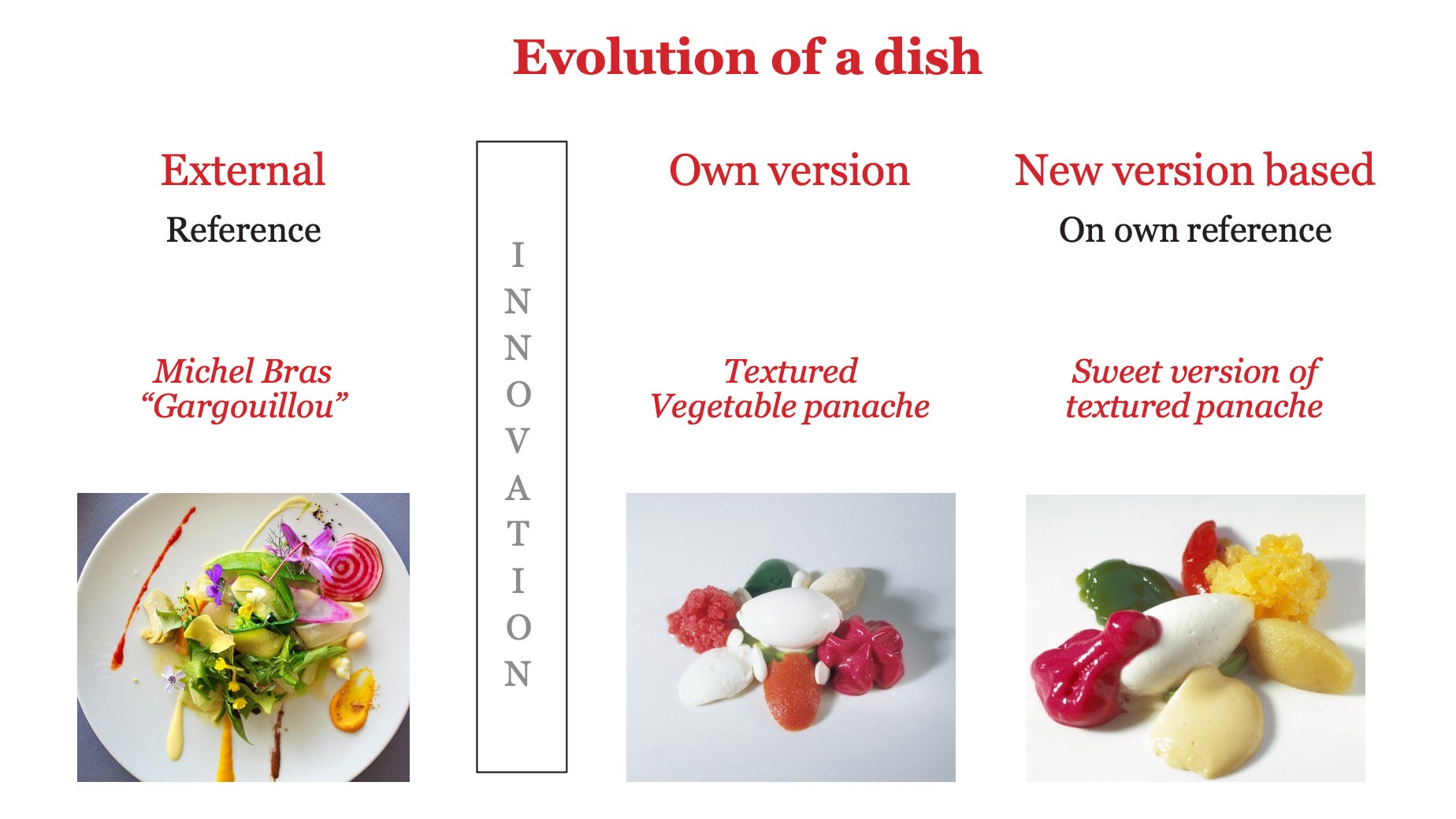
Visual from Pilar's lecture, fall 2024.
Two registers, one building
The argument Pilar built reading elBulli treats the separation as the operation's enabling condition. Innovation and execution in the same room break each other.
Seasons 3 and 4 of The Bear stage what happens when a team tries anyway. The Bear is trying to run elBullitaller and elBullirestaurant at the same time, in the same room.
The Michelin star arrives at the start of season 3. Carmy’s first reading is “I’m trapped.” Sydney reads the same star and starts dialing in the new menu. Both readings are correct. The star is recognition for the elevation and a constraint that locks the operation in place. Once the star is on the wall, the kitchen has to keep producing tasting-menu service every night the doors are open, and the window has to keep producing Italian beef sandwiches. The window funds the restaurant and tethers the team to the actual neighborhood it sits in.
Two operations. Same building. Same team.
Adrià's elBulli handled the tension through separation. Seasons 3 and 4 watch the team handle it without separating.
Then comes “Napkins,” season 3 episode 6. Tina’s pre-Bear backstory. Mikey hires her at The Beef in 2018 by walking up to her at a bar after she’s been laid off and offering her a job on the spot. The episode reframes what was happening at The Beef before any of the recategorization began. The Beef was an established way of running a kitchen and serving a neighborhood with its own internal logic. Mikey hiring Tina off a bar stool was the operation working.
“Gary” continues the reframing into Mikey and Richie’s pre-Bear life. The episode dropped in May 2026 as a bridge between seasons. The prior register is alive in both episodes. The show is treating it as an authentic operation, legible on its own terms.
Seasons 3 and 4 stage a different question. Pilar's paper handles the movement between cultural positions in seasons 1 and 2. Sustained coexistence inside one organization is the question seasons 3 and 4 raise.
Recategorization treats the prior register as the starting condition the team escapes through cultural capital acquisition, but the show keeps insisting the prior register is alive, valid, and continuous with the elevated one. The Beef window stays open because the team needs both. The team needs the income. The team needs the customer base. The team needs the version of itself that existed at The Beef.
The service is the single image of all this at once. A family from Los Angeles is in town. Their daughter is a cancer survivor who has never seen snow. Richie reads the table. He clocks the moment. The family asks for a beef sandwich. Richie heads to the back and starts making it. Carmy intercepts. “Carmen, do not fuck with me.” “Give it to me.” Carmy plates the sandwich. The blue checkered deli paper from The Beef is preserved underneath. The sandwich is quartered. The au jus is in a small ramekin in the center. Sydney’s scallop course later in the same service impresses the same family. The Faks bring fake snow for the closing course. The family eats from both registers off the same set of plates.
Three readings of Carmy’s gesture are simultaneously available. The first reading is overwrite. Carmy is doing what Carmy does, reaching for elevated grammar even when the moment doesn’t call for it. The recategorization reflex.
The second reading is translation. Carmy is using fine-dining technique in service of The Beef’s form. The blue paper is preserved. The au jus is The Beef’s au jus. The plating is recognition of what the family asked for, rendered in the team’s current vocabulary.
The third reading is that both are true at once. The same gesture reads as overwrite from inside Richie’s relationship to the family and as translation from inside Carmy’s relationship to the team. Both readings are operating in good faith. The show declines to adjudicate.
What’s being tested across these readings is who Carmy is caring with, what the care is for, where it shows up, and how it takes form.
Carmy steps away at the end of season 4. The team keeps going.
The model that fits more cleanly is the one Pilar built first. Two contradictory operations, one team. This is a question her elBulli ethnography is full of and her Bear paper doesn't reach.
What’s the relationship between the two when they share a kitchen?
What translation looks like
This question is older than the show. Art and food have been doing the operation for centuries. Giuseppe Arcimboldo painted Holy Roman Emperor Rudolf II in 1591 as a pile of fruits and vegetables. The portrait read as regal and edible at once. The court tradition stayed legible. The vegetable forms stayed legible. Neither subordinated the other. Pop Art did the same thing four hundred years later, importing commercial food’s visual grammar into the gallery, with Warhol’s Campbell’s Soup Cans as the canonical example.
Feminist food artists in the 1970s turned the operation toward domestic kitchen labor. Judy Chicago’s The Dinner Party and Martha Rosler’s Semiotics of the Kitchen run domestic kitchen work and conceptual art in the same room without one absorbing the other.
Rirkrit Tiravanija installed pad thai at the Paula Allen Gallery in New York in 1990 by cooking pad thai and serving it to gallery visitors. The cooking was the artwork. The pad thai was real food. Thai cuisine stayed Thai cuisine. The gallery stayed a gallery. The translation between the fields was what the piece was doing. The visitors were the with that made the piece work.
The pattern is consistent across four centuries. Two fields rendering each other without one absorbing the other. The translation is the work.
Bourdieu’s vocabulary names the operation3. Cultural capital is field-specific. There’s no universal hierarchy that says fine dining sits above Italian beef sandwiches, or that gallery art sits above domestic kitchen work. The hierarchy is something a particular field’s gatekeepers maintain. When a subordinated field generates cultural capital that the dominant field can’t keep ignoring, the dominant field eventually has to catch up. Hip hop is another example.
TL;DR: Markers are how cultural capital becomes visible. Name-drops, collaborations, the rooms you're invited into.
Kraft Dinner to Carbone
Drake’s discography is twenty years of food references mapping recategorization in real time. A single person moving from one cultural position to another, then trying to figure out what to do with the position he left behind.
Talia Caldwell mapped the first part of the arc in 20194. Caldwell traces the food references chronologically. Kraft Dinner in the Degrassi years. Applebees in early mixtapes. By Take Care in 2011 he’s at French Laundry. (I follow the French Laundry on Instagram. I highly recommend you do the same.) By Stay Schemin’ in 2012 he’s name-checking Polo Lounge bolognese. Joso’s, Sotto Sotto, Nobu. Even after the high-end ascent, Drake's defending Cheesecake Factory on 2016's Views. Each reference is a marker of access. By 2019, “Benihana is pigeon food.”
That’s the ascent. Pure recategorization. The prior register declared obsolete. The references work the way fine-dining stages work in The Bear seasons 1 and 2. A demonstration that the cultural capital has been acquired.
Caldwell’s piece read the arc as evolving personhood, treating the Cheesecake Factory and French Laundry references as stages rather than contradictions. Same person across the references, growing from one register to another. This piece extends what Caldwell saw. Drake has overwritten the first register with the second and is now telling everyone about it.
Then the catalog turns.
Instant noodles and Sriracha show up on Lemon Pepper Freestyle. Splitting chicken tenders show up on Away From Home. Drake invests in Dave’s Hot Chicken in 2021. Carbone reservations show up as class detector on Spin Bout U. Sette Mezzo shows up on Middle of the Ocean. “Short rigatoni with the pesto, these verses are my manifesto.” Six years of reaching back.
The instant noodles are being remembered through the grammar of the man who left them behind. The post-2019 catalog tries to reintegrate without abandoning the elevation. Two registers preserved on the same album, neither speaking to the other. The catalog lands at coexistence rather than integration.
Same arc as Carmy. Same temporal pattern as the show. A reading built for the ascent encounters new material from the same subject and has to be extended.
Caldwell’s reading worked for what was available in 2019. Six years of post-peak material has since aired. Both Caldwell’s chronology and Pilar’s framework get extended against new material from their subjects.
Last Friday, May 15, 2026, Drake dropped three new albums totaling forty-three tracks. The food references continue the post-2019 pattern. Lobster ravioli at Serafina on Make Them Pay. Circle K sodas on Fortworth, the lowest rung he’s ever put in a lyric, and unlike Kraft Dinner, it’s present-tense rather than retrospective. The Burning Bridges music video is shot inside Sotto Sotto, the Italian restaurant Drake has called his second home for over a decade. The opening shot follows a hostess past the dining room, past the kitchen, past the storage area, until she reaches the private back room where Drake is with security and old friends and family. The restaurant’s team does the work. Drake is the destination.
A Genius contributor reads "Why you walkin' 'round the facts like you're superstitious?" as facts/Faks, Drake pointing at the family in The Bear whose superstitions run through the kitchen. One contributor, unreviewed. I'd bet against intent. What it tells me is that someone else was holding these two things next to each other.
Drake’s catalog answers the recategorization question one way. Two registers preserved, neither authentic to the other, because the work is solo and there’s no team mediating between them through care.
What does authentic recategorization actually require?
Wing Stop and Nisei
Blvck Svm’s michelinman5 is a hip hop album staged inside fine-dining kitchens. Music videos shot in fourteen kitchens across the US and Canada, from Vern’s in Charleston to AnnaLena in Vancouver. Lyrics at the level of the chef’s mise en place. Hamachi collars in mezcal and miso marinades. Tarragon butter.
Ben Glover, who records as Blvck Svm, ate at Atelier in Chicago in late 2023. The dinner had the same effect Drake’s first French Laundry meal had on him. The difference is what came next.
As a UChicago undergrad, Glover had written his thesis, From Minstrelsy to Migos6, on white American consumption of trap music. The argument was that white enjoyment of trap repeats minstrelsy’s racial dynamics. Black culture becomes thrilling content for audiences who never inhabit the conditions that produced it. With michelinman, a Black rapper takes fine dining seriously, treats the chefs as peers, and folds the technique into hip hop without flattening either field.
Glover decided his next album would be a tasting menu in audio form. He partnered with Atelier's chef on the first track, then kept going. The project runs as a collaboration across fourteen fine-dining kitchens in the United States and Canada. Listening-party dinners at BRUTØ in Denver and Octavia in San Francisco where the chef builds courses to the tracks.
KQED has the full backstory on how the project started at Atelier.
Blvck Svm starts at the register the piece has been calling integrated. No ascent. No peak. No declaration that the prior register is obsolete. Hip hop and fine dining held simultaneously, neither subordinated, both carrying the record.
The reason it works is mutual care across the field boundary. David Yoshimura at Nisei treats Glover as a peer. Byron Gomez at BRUTØ meets him on hip hop’s terms. The collaboration is the work. Glover and the chefs are operating together with recognition flowing both ways, each side treating the other as a peer.
His collaborator Max He:
"He talks about the waiter sprinkling lemon pepper on his wings at Wing Stop in the same way he does about sashimi from Nisei."
Authentic recategorization holds both registers with the same care.
Carmy gets close when he’s working with the team. He can’t sustain it on his own because his care is still split. Drake reaches for it across his post-2019 catalog and lands at coexistence because the work is solo. Blvck Svm starts there because the relationships were already in place.
The art tradition has been running this operation for centuries. Tiravanija cooking pad thai in a New York gallery. Pop art importing commercial food’s grammar into the gallery. Arcimboldo rendering imperial portraiture in vegetable forms. Each is mutual translation operating across a field boundary that the dominant field treats as a hierarchy.
Blvck Svm is the contemporary case. The Bear is a fictional case staged across multiple seasons. The art tradition is the historical case across multiple centuries. What ties all three is that authentic recategorization runs through care.
At elBulli, Adrià kept innovation and execution apart. The Bear runs a similar tension in one kitchen at once. What holds it together is care.
Six questions
Marcus Collins is a marketing professor at Michigan Ross who runs a short video series called Check the Rhyme. Each episode unpacks a single hip hop lyric as a marketing concept. KRS-One on segmentation. Kendrick on authenticity. Pusha T on conviction. The implicit claim is that hip hop's form forces rigor academic prose can route around. A bar that doesn't ring true gets called immediately.
The full playlist is here.
Collins draws from David Brown Jr.7 for his definition of authenticity. To be authentic is to be one’s most honest self regardless of context. Collins’s 2023 book For the Culture8 is the long version of the argument. Authenticity is one register that holds across contexts.
The questions are the ones Richie's daughter Eva is learning in school. Who, what, when, where, why, how. Care is what tenderness looks like when you specify what it requires. Each is a different axis. Every act of care, and every recategorization gesture, answers all six. The answers across the axes are what make a gesture authentic to the people inside it.
Who you care about. Care is always for someone or with someone. Richie’s care at the service is for the family with the cancer-survivor daughter and with the team that built the moment. Carmy’s “give it to me” interrupts the with. Drake’s solo catalog has no with. Blvck Svm’s project is structurally built on with: with the chefs at fourteen kitchens, with Max He, with the listening dinner audiences. The with is what allows recategorization to be mutual. Without the with, it stays directional.
What you care about. Drake at French Laundry cares about being someone who eats at French Laundry. Blvck Svm at Atelier cares about the food at Atelier. Carmy at the service has the family in view and the elevated grammar in view at the same time. Richie’s gesture is fully about the family. The object of his care is the moment the family will have with the food. Same gesture from outside, different object underneath.
When you care. Care that only shows up at the moment of public gesture is care for the gesture. Richie’s care started before the family arrived and is sustained across services, across years. Carmy’s care at the service is real but episodic. Blvck Svm’s care has been sustained across an album, across fourteen kitchens, across years of relationships. Care that keeps being expensive over time is real care.
Where you care. Expensive rooms are where care gets seen, which is not the same as where it happens. Richie’s care started in the back of the house, before the gesture became visible to the family. Carmy’s care shows up at the pass during plating. Blvck Svm’s care shows up in fourteen kitchens, on records, at listening dinners, in his collaborator relationships. The location of visible care indexes what the care is actually for.
Why you care. Care for relational reasons translates. Care for positional reasons signals. Care for generative reasons creates new work. Richie cares because Ever taught him to care, and the care has become how he operates. Drake cares because the references position him. Blvck Svm cares because the technique opens something up in his writing, and that opening produces new work. Carmy’s why at the service is mixed: he cares about the family and about whether the plating reads as elevated.
How you care. Care expressed through technique elaboration is different from care expressed through reading the table. Both can be authentic. They’re testing different axes. Carmy’s how at the service is technique-forward (the quartered sandwich, the centered ramekin). Richie’s how is recognition-forward (the read of the table, the unprompted gesture). Drake’s how is reference-forward (the lyric drops the name). Blvck Svm’s how is collaboration-forward (the kitchen and the studio operating as one space). The form the care takes shows what it's for.
The six axes are a way to read any moment carefully. Carmy at the service has the family in view (who, why), but the object is mixed (what), the gesture shows up only at the pass (where), it leans technique-forward in a moment that may not have called for it (how), and he’s about to step away (when). Richie’s gesture holds all six. Blvck Svm’s project holds all six. Drake’s catalog holds some and lands at coexistence on others.
Which is why Carmy steps away at the end of season 4.
What Carmy is leaving behind
The third season finale ended with Carmy confronting David Fields at Ever’s funeral dinner. Fields was the New York chef who gave Carmy his ulcers, his panic attacks, and his nightmares. Carmy tried to hold him to account.
“You were an OK chef when you started with me. And you left an excellent chef. So you're welcome.”
“You gave me ulcers and panic attacks and nightmares.”
“Yeah, I gave you confidence and leadership and ability. It fucking worked.”
“My life stopped.”
“That’s the point.”
"That's the point." —Chef David Fields, The Bear (S3 finale)
That’s the logic Carmy spent the early seasons running on. Greatness through suffering. Hierarchy as engine. No with. No care for the people the operation is built on. Fields’s “I made you great” is the cleanest articulation of recategorization-as-overwrite the show has put on screen. The variables of care don’t appear in his vocabulary. He has only one variable: outcome.
Then comes “Bears,” season 4 episode 79. The wedding of Richie’s ex-wife Tiffany. Sixteen people end up under the same table because Richie’s daughter Eva is hiding there. She doesn’t want to dance with her stepfather Frank. Frank goes under to be with her. Richie goes under. Claire goes under. Carmy sees Richie’s legs sticking out and joins them. Sydney goes under. The Faks go under. Francie goes under.
Each person shares something they’re afraid of, to show Eva that it’s okay to be scared.
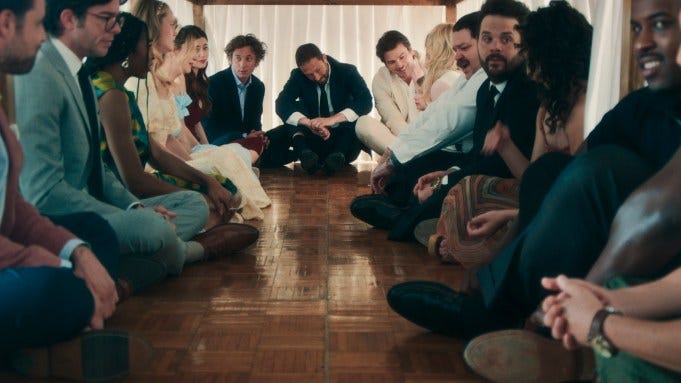
The scene maps cleanly to all six axes of care. Who: with each other, for Eva. What: the moment Eva needs, not a position to protect. When: sustained across years of the team becoming a family. Where: under the table, out of sight of everyone at the wedding. Why: relational, with no positional payoff. How: presence-forward, vulnerability-forward.
This is what tenderness looks like when it’s specified. Six axes lit up at once. No conflict between readings. The team operating in the integrated register.
The episode is also where Carmy reconciles with Lee, who tells him how proud Mikey was of him. And with Claire, who he hasn’t seen since the season 2 breakup. They dance. She asks if it’s going to burn him alive. He says it won’t.
Carmy is doing his own care work in this episode. With Claire. With his family. With himself.
The team has been doing the operational work for years. Marcus’s mentorship. Richie’s transformation. Sydney’s leadership. Tina’s growth. The Faks. The integrated register the team built across seasons 1 through 4 is theirs.
Carmy’s care across the same years has been real and incomplete. Real because he loves the team and the work. Incomplete because Fields’s grammar is buried inside it. The assumption that the elevation justifies the operation. The assumption that suffering is the price.
By the end of season 4 he steps away.
The team’s authentic version of the operation can continue without Carmy’s recategorization reflex stepping on it. Stepping out is what lets them keep what they built.
Sixteen people under the table
Can recategorization be authentic?
Yes, when care shows up across all six axes.
The Bear is staging the long version. Drake is rapping the same arc, still in progress, landing at coexistence after the peak. Blvck Svm is showing what authentic mutual recategorization looks like when it starts with the relationships in place. The art tradition has been doing this work for centuries.
Carmy stepping away at the end of season 4 means the team can keep what they built without him at the pass.
Season 5 is the show’s final season. Sydney, Richie, and Natalie wake up to find Carmy has quit the food industry and left the restaurant in their hands. They’re going for one last service to earn a Michelin star. The official synopsis ends with: “what makes a restaurant perfect might not be the food, but the people.”
That’s my argument, in the show’s own words.
Sixteen people went under one table at one wedding. The integrated register the team built is real. Whether they can sustain it through that final service is what the last season will tell us.
I can’t wait for season 5.
The first-ever Bvck of House video, filmed at Vern’s in Charleston as a bonus performance of “houstoncomet,” is the moment the project’s premise was first proven on camera.
Opazo, M. Pilar. Appetite for Innovation: Creativity and Change at elBulli. Columbia University Press, 2016.
Opazo, M. Pilar. “Cooking Up Organizational Change at the Bear: A Media Review.” Organization Studies, 2024.
The cultural capital concept comes from Pierre Bourdieu, Distinction: A Social Critique of the Judgement of Taste (1979).
Caldwell, Talia. “The Evolving (yet Contradicting) Taste Buds of Drake.” Five Fifths Culture, July 12, 2019.
Released November 11, 2024 by Takamori Tallow. Thirteen tracks, recorded in collaboration with fourteen fine-dining restaurants across the US and Canada. Project backstory documented in WTTW Chicago, April 15, 2025, and KQED, November 2024.
Ben Glover. From Minstrelsy to Migos: An Examination of White American Enjoyment of Trap Music. University of Chicago undergraduate thesis.
Collins draws the authenticity definition from designer and educator David Brown Jr.
Collins, Marcus. For the Culture: The Power Behind What We Buy, What We Do, and Who We Want to Be. PublicAffairs, 2023.
“Bears,” season 4 episode 7. Written by Joanna Calo. Directed by Christopher Storer. Released on Hulu, June 25, 2025.